
Training
Progressive Overload in Calisthenics: How to Get Stronger
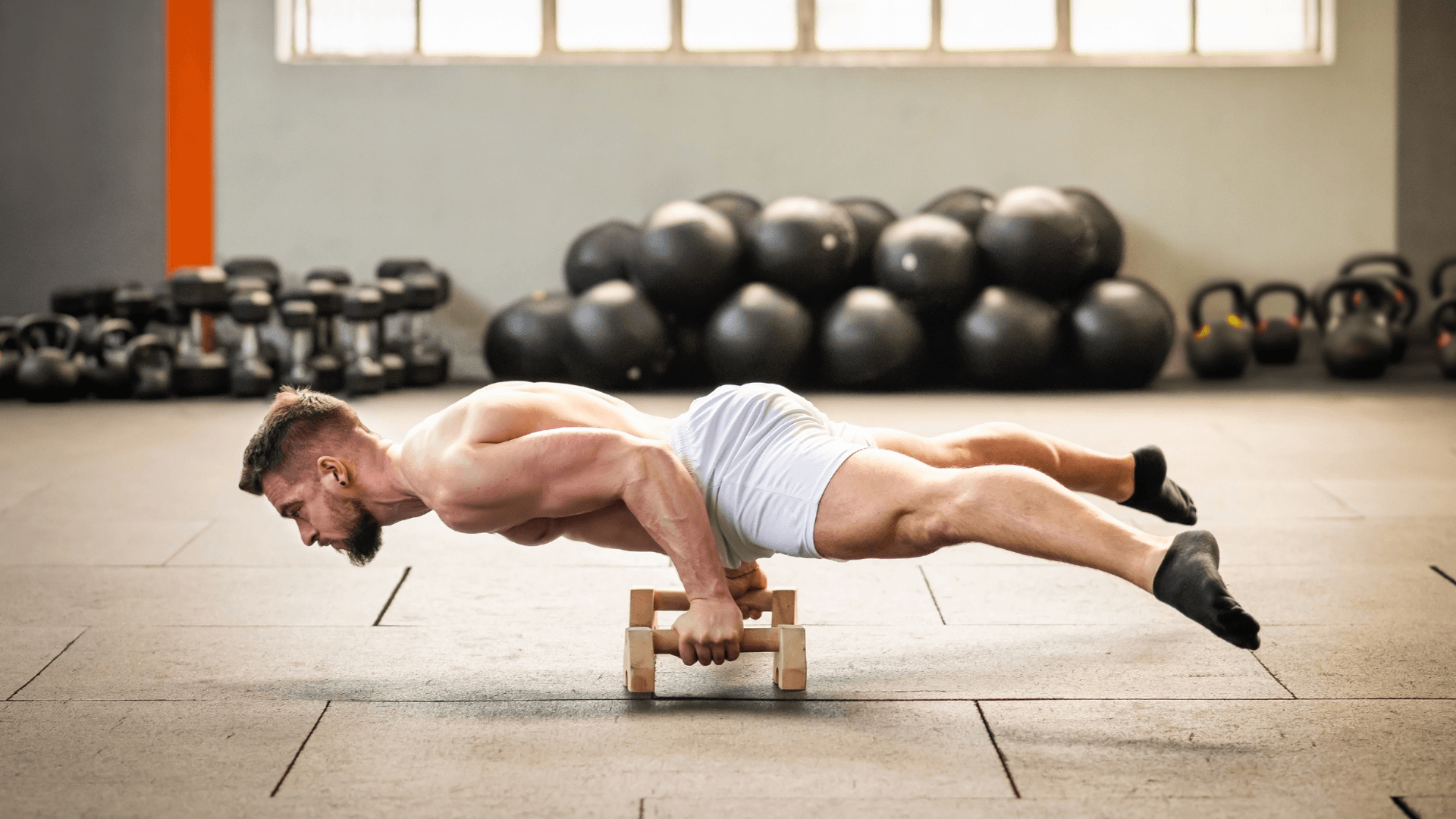
If you come from weight training, progressive overload usually feels very straightforward.
You squat 185 pounds.
A few weeks later, you squat 195.
The number went up. The exercise got harder. Progress is easy to see.
Then you start calisthenics and the whole thing feels less obvious.
How do you progressively overload a push-up if you are not adding plates?
How do you make a bodyweight row harder?
What does progression look like on rings?
How do you know when it is time to move from one handstand, pull-up, or lever progression to the next?
This is where people sometimes assume calisthenics is less measurable than traditional strength training.
It is not.
You are still applying the same basic principle: the body needs a gradually increasing training demand if you want it to keep adapting.
The difference is that in calisthenics, load is not controlled only by the number on a bar.
You can increase difficulty through leverage, range of motion, exercise variation, assistance, repetitions, sets, hold time, tempo, and movement quality.
At MOVE, that is a big part of how we coach bodyweight strength.
Progressive overload in calisthenics is not about making every exercise look more advanced as quickly as possible. It is about increasing the demand while keeping the movement useful enough to keep progressing.
What Is Progressive Overload?
Progressive overload means gradually increasing the training demand placed on the body over time.
That idea is not unique to calisthenics.
It is a basic principle of resistance training.
The classic American College of Sports Medicine position stand on resistance-training progression describes progression as necessary when the goal is continued adaptation.
The important word is progression.
If you keep performing exactly the same amount of work at exactly the same difficulty forever, eventually your body has less reason to change.
That does not mean every workout has to be harder than the previous workout.
Progress is rarely that linear.
It means the training demand should increase over time as your capacity improves.
In a gym, adding weight is one obvious way to do that.
In calisthenics, you have more variables to work with.
Adding Weight Is Only One Form of Progressive Overload
External load is useful because it is easy to measure.
If your weighted chin-up moves from 10 pounds to 20 pounds, the progression is obvious.
But adding weight is not the definition of progressive overload.
It is one tool.
A 2018 study comparing progressive push-up training with bench press training found that a calisthenics program using progressively harder push-up variations improved upper-body strength. Both the push-up and bench press groups improved their one-repetition-max bench press, while the calisthenics group improved the push-up progression more.
Another study found that push-ups and bench press produced similar strength gains when the exercises were matched for comparable muscle activity and loading demands.
The point is not that push-ups are better than bench press.
It is that bodyweight exercises can be progressively overloaded when the exercise itself is changed in a systematic way.
That is the part many people miss.
1. Use a Harder Exercise Variation
This is probably the most recognizable form of calisthenics progression.
Instead of adding weight to the same exercise, you move to a variation that creates more resistance.
A beginner push-up progression might look something like:
- Wall push-up
- High incline push-up
- Lower incline push-up
- Floor push-up
- Feet-elevated push-up
- More advanced unilateral or ring variations
The movement family stays similar.
The resistance changes.
Pulling can work the same way.
You might move from:
- High ring row
- Lower ring row
- Feet-elevated ring row
- Assisted chin-up
- Bodyweight chin-up
- Weighted chin-up
The exact sequence will differ depending on the person.
But the principle stays the same.
As the current version becomes manageable, the next version asks more from you.
2. Change the Leverage
Leverage is one of the biggest reasons calisthenics can become extremely difficult without adding any external weight.
Small changes in body position can dramatically change how much torque the muscles have to produce.
A front lever is a clear example.
A tuck front lever brings more of your body mass closer to the shoulders.
As the hips open and the legs extend farther from the body, the lever arm increases.
The exercise gets harder even though your bodyweight did not change.
The same principle appears in:
- Planche progressions
- Front lever progressions
- Back lever progressions
- Bodyweight rows
- Push-ups
- Core exercises
- Some handstand strength work
This is one reason a progression can look like a small visual change but feel dramatically different.
You are changing the mechanics.
At MOVE, we do not move someone to a longer lever just because the next progression looks more exciting.
We want the current version to be controlled enough that the additional leverage is a useful step rather than a complete breakdown.
3. Increase Range of Motion
Another way to overload a movement is to perform it through a larger range.
Think about a push-up.
A shallow push-up and a controlled chest-to-floor push-up are not the same exercise demand.
A ring push-up can allow the shoulders to move through more range than the floor.
A dip can progress from a shallower range to a deeper range when the shoulders are prepared for it.
A squat can become more demanding when the person develops enough mobility and control to use more depth.
Research supports the value of full-range resistance training in many contexts. A 2021 systematic review and meta-analysis found that full-range training produced greater overall strength adaptations than partial-range training in the included studies, with advantages for lower-body hypertrophy as well.
That does not mean partial repetitions are bad.
They can be useful for specific goals.
But range of motion is another variable you can progress.
And in calisthenics, increasing range can sometimes make an exercise much harder without changing anything else.
4. Add Repetitions
Sometimes the simplest progression is the right one.
You do five clean chin-ups.
Then six.
Then seven.
That is progressive overload.
You do eight push-ups with good control.
A few weeks later, you can do twelve.
The exercise did not change, but your capacity did.
For a lot of beginner and intermediate calisthenics work, adding repetitions before changing the variation makes sense.
It lets you build familiarity and volume while giving you a clear benchmark.
The mistake is staying with the same variation forever once the rep count becomes so high that it no longer matches the quality you are trying to develop.
If your goal is strength and you are doing 30 or 40 easy repetitions, changing the exercise may become more useful than continuing to add reps.
5. Add Sets or Total Work
Progressive overload can also mean doing more total quality work.
If you perform three sets of five rows this month and later perform four sets of five with the same form and difficulty, your training volume increased.
That matters.
Training volume is one of the variables associated with strength and muscle adaptations. A systematic review and meta-analysis on weekly resistance-training volume found a dose-response relationship between weekly set volume and muscle hypertrophy across the included studies.
More is not automatically better forever.
Recent research also suggests the relationship between training dose and strength is not endless and linear. A 2026 systematic review and meta-analysis found a non-linear dose-response, meaning that increasing training dosage eventually produces diminishing returns.
That is an important distinction.
Adding sets can be progression.
Adding random volume until your performance gets worse is not.
6. Increase Hold Time
Isometric skills give us another easy progression variable: time.
If you can hold a tuck front lever for five seconds and later hold the same position for ten seconds with the same body line, you improved.
The same idea applies to:
- Ring support holds
- L-sits
- Handstand holds
- Hollow-body positions
- Side planks
- Some planche and lever progressions
Time is useful because it gives you a simple measurement.
But the position matters.
A ten-second hold in a strong position is not automatically equivalent to a twenty-second hold where the shape changes halfway through.
At MOVE, we care about what you are holding, not just how long the clock runs.
7. Reduce Assistance
Assistance is one of the most useful progression tools for beginners.
If you cannot perform a chin-up yet, that does not mean the movement is unavailable to you.
We can change how much of your bodyweight you have to move.
That might mean:
- Using a resistance band
- Keeping one or both feet supported
- Using a partner or machine for assistance
- Adjusting the angle of a row
- Using a box for a dip progression
Then, over time, you reduce the help.
A thick band becomes a thinner band.
Two feet become one foot.
A high ring row becomes more horizontal.
The exercise is progressively overloaded because you are doing more of the work yourself.
This is one reason calisthenics works well for beginners when it is coached properly.
A movement does not have to be all-or-nothing.
8. Change Tempo and Control
Slowing down a repetition can make an exercise feel dramatically harder.
A three-second lowering phase on a push-up creates a different demand than dropping quickly into the bottom.
Pausing at the hardest point can remove momentum.
Controlling the transition on rings can expose positions you were previously rushing through.
Tempo can be useful for:
- Learning control
- Building awareness
- Spending more time in a difficult position
- Making a current progression more challenging before changing exercises
But tempo needs some nuance.
A 2025 systematic review and meta-analysis on repetition tempo found that slower versus faster repetition tempos had minimal overall differences for muscle hypertrophy across the included studies.
So moving as slowly as possible is not a secret shortcut to more muscle.
At MOVE, tempo is often more useful as a coaching and progression tool.
It can show us whether you actually control the range.
It can take momentum away.
And it can make a familiar movement more demanding without immediately jumping to a harder skill.
Better Technique Can Be Progress Too
This one gets overlooked because it does not always produce a bigger number.
But imagine two sets of five pull-ups.
In the first month:
- You swing between reps
- The chin barely clears the bar
- The shoulders shrug
- The last two reps are completely different from the first three
Three months later:
- The body stays controlled
- The range is consistent
- The shoulders move well
- Every rep looks similar
The rep count is the same.
The performance is not.
Better movement quality can mean you are applying more of your strength through the intended positions instead of finding ways around the difficult parts.
That matters even more in gymnastics-inspired training because positions often become the foundation for later skills.
We do not want someone to progress an exercise by making the current exercise worse.
Harder Is Not Automatically Better
This is probably the biggest mistake people make with calisthenics progressions.
They think progression means moving to the most advanced variation they can technically survive.
It does not.
Imagine someone working toward a front lever.
Their tuck lever is controlled for ten seconds.
They try an advanced tuck and can hold it for two seconds, but the hips drop immediately and the shoulders lose position.
Is the advanced tuck technically harder?
Yes.
Is it currently a better training exercise for that person?
Not necessarily.
The same thing happens with:
- Handstand push-ups
- Ring dips
- Planche progressions
- Pistol squats
- Muscle-ups
- Pull-ups
A harder variation is only useful if you can perform enough quality work with it to create adaptation.
Sometimes the best progression is another month of the “easier” version with better volume, range, or control.
Difficulty is not the goal. Progress is.
Do Not Progress Every Variable at Once
You have a lot of ways to make calisthenics harder.
That does not mean you should use all of them at the same time.
Suppose you are doing ring push-ups.
In one week, you:
- Lower the rings
- Increase the range
- Add two reps per set
- Add another set
- Slow the eccentric
- Turn the rings out farther
That is a lot of new demand at once.
If your shoulders or elbows start getting irritated, you will not know which change was too much.
A cleaner progression changes one or two variables while keeping the rest relatively stable.
Maybe you add reps first.
Then lower the rings.
Then build the reps again.
That makes the progression easier to track and easier to recover from.
Progressive Overload Does Not Mean Every Workout Must Improve
This is important.
Progressive overload describes the direction of training over time.
It does not mean:
Monday: 8 reps
Wednesday: 9 reps
Friday: 10 reps
Real training is not that predictable.
Sleep changes.
Stress changes.
Some days you feel strong.
Other days the same exercise feels heavier.
You may stay on the same progression for several weeks while your technique, volume, and tolerance improve.
That is normal.
If the trend over time is moving forward, the program can be working even when the number does not increase every session.
Our article on how hard you should train goes deeper into why every workout does not need to be a max-effort session.
How a Coach Decides the Next Progression
This is where calisthenics gets much easier with coaching.
There are often several ways to progress the same skill.
A coach has to decide which one makes the most sense for the person in front of them.
At MOVE, we may look at questions like:
- Can you repeat the current movement for multiple sets?
- Does the position stay consistent as fatigue builds?
- Do you have enough range of motion for the next version?
- Are your joints tolerating the current workload?
- Is strength really the limiting factor?
- Would more volume help more than a harder variation?
- Does changing leverage make sense?
- Does the next progression match the skill you actually want?
Two people can perform the same number of push-ups and need completely different next steps.
One may need more pressing strength.
Another may need shoulder mobility.
Another may be ready for ring work.
Another may benefit from adding external load.
The next progression is not chosen from a universal chart.
It is chosen from what the person needs.
A Pull-Up Progression Example
Imagine you want to build your first strict chin-up.
Progressive overload could look like this:
Phase 1: Build rowing strength
Start with ring rows at an angle you can control.
Progress by:
- Adding reps
- Lowering the rings
- Moving the feet farther forward
- Elevating the feet
- Increasing range
Phase 2: Add vertical pulling
Use assisted chin-ups.
Progress by:
- Reducing band assistance
- Reducing foot support
- Adding controlled eccentrics
- Increasing repetitions
Phase 3: Build the first full rep
Practice clean single repetitions while keeping assisted volume in the program.
Phase 4: Build repeatable volume
One rep becomes two.
Two becomes three.
Then several controlled sets.
Phase 5: Add difficulty
Once bodyweight chin-ups are strong and repeatable, progression might involve:
- More reps
- More sets
- Pauses
- Greater range
- Rings
- External weight
There is no moment where the bodyweight training stops being progressive because you did not add a plate.
A Push-Up Progression Example
Push-ups show the same principle very clearly.
You might begin with your hands on a high box.
Then:
- Build to a target number of controlled reps
- Lower the hand position
- Build the reps again
- Reach the floor
- Increase range or use handles/rings
- Elevate the feet
- Shift more load toward one arm
- Add external weight if useful
Notice that we do not need to jump from incline push-ups to a one-arm push-up.
There are many useful steps between them.
That is what makes good programming sustainable.
A Front Lever Progression Example
Straight-arm skills make progressive overload more technical.
The progression may involve:
- Better scapular position
- Longer hold time
- More sets
- A slightly longer lever
- Better hip position
- Less assistance
- More controlled transitions in and out of the hold
You may spend several weeks with the same visible progression while improving the quality underneath it.
Then, when the lever gets longer, the new position is not a complete shock.
This is also where joint preparation matters.
A harder lever does not only increase muscular demand.
It changes the force experienced at the shoulders and elbows.
That is why our article on training joints, not just muscles is closely connected to progressive overload.
Can You Add Weight to Calisthenics?
Absolutely.
Weighted calisthenics is still calisthenics.
Once a movement is strong enough, external resistance can be one of the simplest ways to keep progressing.
Common examples include:
- Weighted pull-ups
- Weighted chin-ups
- Weighted dips
- Weighted push-ups
- Loaded squats and split squats
You do not have to avoid weights to make bodyweight training legitimate.
At MOVE, we combine calisthenics and weight training because each gives us useful ways to control resistance.
If you want more on that, read Calisthenics vs Weight Training: Do You Need to Choose?.
How to Track Progressive Overload in Calisthenics
If you want progression to be measurable, write things down.
You do not need a complicated tracking system.
For each main movement, record the variables that matter.
For reps:
Ring row — feet at marker 3 — 3 x 8
For holds:
Tuck front lever — 4 x 8 seconds
For assistance:
Chin-up — green band — 3 x 5
For range:
Ring dip — controlled to 90 degrees — 3 x 6
For tempo:
Push-up — 3 sec lowering — 3 x 10
Now progression becomes visible.
A month later, you may be doing:
Ring row — feet at marker 4 — 3 x 8
The rep number did not change.
The leverage did.
That is progressive overload.
Why MOVE Starts With Fundamentals
To progress an exercise properly, we first need to know where you are starting.
That is exactly what MOVE’s Fundamentals Program is designed to do.
Every new training member starts with a five-session private coaching series before regular group training. MOVE uses that phase to establish foundational bodyweight control, joint mobility, movement patterns, and positional awareness. The sessions cover lower-body work, pressing, rotator cuff preparation, hanging and pulling, spine and core control, introductory acrobatics, barbell training, plyometrics, and hip flexibility.
The point is not to make you “pass” calisthenics before you can start.
It is to find the right starting progression.
If you already have strong push-ups, we do not need to pretend you are a beginner there.
If your pulling is the limiting factor, we can identify it.
If your wrists or shoulders need more preparation before handstands, we can see that too.
Then progression becomes specific instead of random.
How Progressive Overload Works in MOVE Group Classes
After Fundamentals, MOVE’s group classes combine gymnastics-inspired strength work, weight training, calisthenics, flexibility, skill development, and conditioning.
The programming is designed around progressive overload, but that does not mean every member performs the same variation.
One person may perform incline push-ups.
Another may be on rings.
Another may be working on a harder pressing progression.
The movement pattern may be shared.
The resistance is individualized.
That is one of the advantages of calisthenics when it is coached well.
There is almost always another way to adjust the difficulty.
Progressive Overload Should Make You Better, Not Just More Tired
The simplest way to think about this is:
You need more challenge over time.
But the challenge has to remain productive.
You can progress through:
- Harder exercise variations
- Longer levers
- More range of motion
- More repetitions
- More sets
- More total work
- Longer holds
- Less assistance
- Better control
- Strategic tempo changes
- External weight when appropriate
You do not need to use all of them.
You need the one that makes sense next.
That is the difference between progression and just making training harder.
The goal is not to constantly find a more difficult exercise. The goal is to become more capable at the exercises and skills you care about.
Frequently Asked Questions
What is progressive overload in calisthenics?
Progressive overload in calisthenics means gradually increasing the training demand over time. That can happen through harder variations, longer leverage, more range of motion, more reps or sets, longer holds, less assistance, better control, or added external weight.
How do you progressively overload without adding weight?
You can change leverage, use a harder exercise variation, increase range of motion, add repetitions or sets, increase hold time, reduce assistance, or use tempo and pauses to increase the difficulty.
When should I move to a harder calisthenics progression?
Move on when the current progression is controlled, repeatable across multiple sets, and no longer provides enough challenge for your goal. A harder variation is not useful if technique breaks down immediately or you cannot accumulate meaningful work.
Should I add reps or move to a harder variation?
Both can work. Beginners often benefit from building a reasonable rep base before changing variations. If the rep range becomes very high relative to your strength goal, a harder variation may be more efficient.
Can tempo be progressive overload?
Tempo can increase the difficulty of a movement and improve control, particularly by slowing the eccentric phase or adding pauses. But slower is not automatically better. Tempo should support the goal rather than being used only to make every exercise feel harder.
Can I use weights for progressive overload in calisthenics?
Yes. Weighted pull-ups, dips, push-ups, and other movements are useful ways to progress once the bodyweight version is strong. Calisthenics and external resistance can complement each other.
How often should I progress an exercise?
There is no fixed schedule. Progress when your performance shows that the current level is becoming manageable and your recovery is good. Some movements progress weekly; advanced skills may stay on the same variation for months while hold time, volume, range, and quality improve.
Want to Know What Your Next Progression Should Be?
Calisthenics gets frustrating when every progression is guesswork.
You do not need to start with the hardest version you can survive.
You need the version that gives you enough challenge to improve and enough control to repeat good work.
That is what we establish in Fundamentals at MOVE.
If you want to start calisthenics, improve your current skills, or figure out why you have been stuck on the same progression, book a free one-on-one intro with a MOVE coach.
We will look at where you are now and what should come next.
Research References
- American College of Sports Medicine. Progression Models in Resistance Training for Healthy Adults. Medicine & Science in Sports & Exercise. 2002.
- Kikuchi N, Nakazato K. Effect of Progressive Calisthenic Push-up Training on Muscle Strength and Thickness. Journal of Strength and Conditioning Research. 2018.
- Calatayud J, et al. Bench Press and Push-Up at Comparable Levels of Muscle Activity Results in Similar Strength Gains. Journal of Strength and Conditioning Research. 2015.
- Pallarés JG, et al. Effects of Range of Motion on Resistance Training Adaptations: A Systematic Review and Meta-analysis. Scandinavian Journal of Medicine & Science in Sports. 2021.
- Schoenfeld BJ, et al. Dose-response relationship between weekly resistance training volume and increases in muscle mass: A systematic review and meta-analysis. Journal of Sports Sciences. 2017.
- The Influence of Individual Resistance Training Variables on Muscle Strength: A Systematic Review and Meta-analysis. 2026.
- Enes A, et al. How Slow Should You Go? A Systematic Review With Meta-Analysis of the Effect of Resistance Training Repetition Tempo on Muscle Hypertrophy. Journal of Strength and Conditioning Research. 2025.
- MOVE GST. Fundamentals Program.
- MOVE GST. Group Classes.
Ready to put this into practice?
Book a free intro with a MOVE GST coach — they'll build a plan around you, not a template.
Book Your Free Intro