Training
Calisthenics or barbell? You don't have to choose.
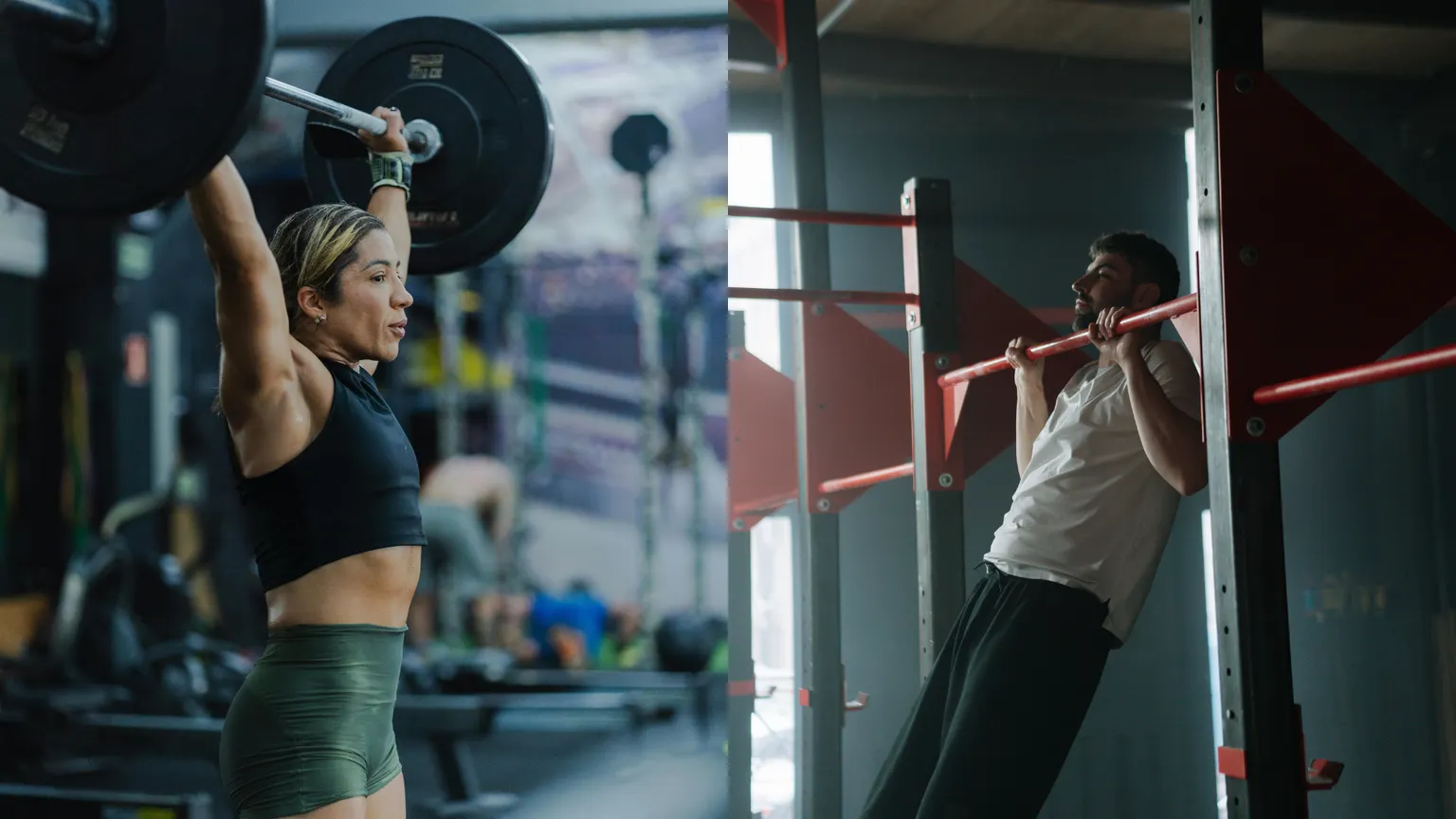
Most people frame it as a fight. Calisthenics on one side, barbells on the other, and you have to pick a team. That framing has cost a lot of people years of progress. If your squat has stalled because your hips won't open, the barbell isn't your problem. If your ring work has plateaued because you can't generate tension through a loaded hip hinge, bodyweight alone won't fix it. Calisthenics and weight training are not competing systems. They are two halves of the same question: can your body produce force through its full range of motion?
The stall nobody talks about
You know the feeling. You have been training consistently, maybe for years. The deadlift numbers went up, then stopped. The squat feels grindy above a certain weight, and somewhere in the back of your head you know your hips are part of the reason. Or you started working on a muscle-up or a handstand and hit a ceiling you can't explain, because you are strong enough on paper but the skill won't come together.
This is not a programming problem. It is a range problem. Your body has built strength inside a narrow window of motion, and anything outside that window feels unstable, painful, or just impossible. The hips that won't open below parallel. The shoulders that drift forward the moment a press gets heavy. The thoracic spine that refuses to extend, turning every overhead rep into a lower-back compensation. If this sounds familiar, the stall you are experiencing is not about effort. You are probably working hard. It is about the fact that strength without range has a ceiling, and you have found yours.
The people who keep making progress past forty, who are squatting deeper and pressing more cleanly at fifty than they were at thirty-five, have figured out something simple: range is not a flexibility add-on. It is the foundation the strength sits on. Tight hips are one of the most common reasons a squat stalls, and no amount of extra loading fixes a mobility problem.
Why choosing one or the other hasn't worked
The barbell-only path has a predictable ending. Load goes up, compensation patterns get trained in alongside the strength, and eventually something that was always tight becomes something that hurts. Physical therapy gets you out of pain, but it rarely puts you back where you were. Insurance runs out before the real work is done. You come back to training a little more cautious, a little more protective of the thing that broke, and the cycle repeats.
The calisthenics-only path has its own version of the same problem. Bodyweight training done well builds extraordinary relative strength and body awareness. But without external load, there are movement patterns that simply do not develop the same way. A heavy Romanian deadlift teaches the posterior chain something that no bodyweight drill replicates at the same intensity. A loaded carry builds trunk stability under conditions that ring work alone does not produce. People who leave barbells out entirely often develop blind spots in their posterior chain and struggle to generate the kind of full-body tension that makes advanced skills actually safe to train.
The pattern that shows up again and again is this: someone strong on a barbell tries to learn a handstand or work on rings and finds the skill frustrating and slow, because the positional awareness and shoulder stability they need are underdeveloped. Someone who has trained bodyweight for years walks into a barbell program and finds their hip hinge is weak and their loaded squat falls apart under real weight. Neither person is unfit. Both have a gap, and the gap is exactly the place where the two systems would have covered each other.
Big-box gyms and large group classes are not built to catch this. When a coach is managing twenty people in a class, nobody is watching whether your thoracic spine is locked up at the top of your press. You get the workout. You do not get the correction. And so the compensation gets stronger every session, not weaker.
What the real problem actually is
The debate between calisthenics and weight training is a distraction from the actual question, which is: does your body move well under load, through its full range, without bracing against itself? That is the standard. Everything else is just a tool for getting there.
When you squat with a barbell, you need mobile hips, a stable trunk, and ankles that can dorsiflex without compensating. Those are not barbell skills. They are human movement skills, and calisthenics training, particularly the kind that includes gymnastics-based work and deliberate positional training, builds them directly. When you work a support hold on the rings, you need scapular stability and shoulder external rotation that most barbell programs ignore entirely. That stability, once you have it, makes your overhead press safer and your bench stronger, because the shoulder is finally working the way it is supposed to.
This is what Strength With Range means as a training principle. Not strength, then flexibility as a separate project. Not mobility work tacked on at the end of a session you are already tired from. Range built into every pattern, so the strength you develop is available across the full arc of motion, not just in the narrow slot where you trained it.
The handstand is a useful example because it makes the demand visible. To hold a handstand against a wall, you need to stack your joints cleanly: wrists, elbows, shoulders, hips, knees, ankles, all in one line. If your thoracic spine is stiff, you cannot achieve that line. If your shoulder external rotation is poor, the load shifts to your passive structures and the hold feels precarious. The handstand does not care how much you bench. It cares whether you can actually control your body in space. And once you can, the shoulder stability and proprioception you have built will show up in your barbell work in ways that feel almost unfair.
How to train calisthenics and weight training together, systematically
The integration is not random. It follows a logic: mobility work earns the range, barbell work loads the range, and skill work proves it. Each discipline tests the others. Here is what that looks like in practice.
Build the foundation with range, not load
Before adding weight to a movement, you need to own the position. That means a squat that reaches full depth with no forward lean and no hip pinch, an overhead position with no rib flare, a hip hinge that loads the hamstrings without rounding the lower back. These positions are developed through deliberate mobility work, not through stretching at the end of a session, but through loaded positional training: deep squat holds, banded hip flexor work, thoracic extensions on a foam roller, overhead work with dowels before barbells. At MOVE, this is part of what the first sessions with a coach are designed to find. Here is what those first five sessions actually look like.
Use barbell work to load what you have built
Once the range is there, barbells are extraordinarily efficient at building strength through it. The back squat, deadlift, press, and row are not being replaced by calisthenics. They are being done in positions that are actually safe to load, which changes what the body builds. A squat done to full depth with open hips trains the glutes and adductors in a way that a parallel squat never reaches. A press done with a stable, mobile shoulder builds the rotator cuff alongside the deltoid. The load is the same. The range is what makes the difference.
Use skill work to prove it and extend it
Gymnastics-based skills, specifically the ring support, the hanging work, the wall handstand, and intro tumbling, serve as tests of what the barbell work and mobility work have built. They also extend it. The ring support demands scapular depression and shoulder external rotation under load in a position no barbell exercise trains. Hanging from a bar decompresses the spine and develops grip and shoulder health simultaneously. The wall handstand teaches you to stack your joints and control your body with precision that carries directly into cleaner barbell mechanics. These are not party tricks. They are movement standards, and they reveal gaps that loaded barbell training tends to paper over.
Train the two systems together, not sequentially
The mistake is treating mobility and skill work as a phase that ends when real training begins. The progression never stops. At MOVE, members who have been training for three years are still developing their handstand, still refining their hip hinge, still finding new range in their thoracic spine. The barbell numbers keep going up because the foundation keeps expanding. This is what training for the long haul actually looks like: not a linear climb to a peak, but a continuous expansion of what the body can do.
What this looks like for real people
The Google reviews for MOVE tell a consistent story. Members describe being the strongest they have been in ten years, after spending significant time on mobility work they initially resisted. Physicians and a physical therapist have written reviews. People who came in after spine surgery and joint replacements have written reviews. The pattern across those 155 reviews, 153 of them five-star, is not that MOVE made people more flexible. It is that members got stronger when they stopped treating range as optional.
The member who finally squats below parallel after years of hip pinching does not just feel better in the squat. They find their deadlift goes up, their lower back stops nagging, and their knee pain, which they had accepted as permanent, fades. These outcomes are connected. The hip that moves freely distributes load the way it is supposed to. Every joint downstream benefits.
The member who could not kick up to a handstand six months ago, who had solid barbell numbers and assumed the skill would come easily, finds that the work to get the handstand cleans up their overhead press in ways they did not expect. The shoulder stability and positional awareness carry over. That is not a coincidence. It is the system working.
Where do you start?
The practical answer is: with a coach who can see where your range is limiting your strength. You cannot assess that yourself, not accurately. You have been living in your compensation patterns long enough that they feel normal. A coach looking at your squat, your press, your hip hinge, and your shoulder position in a support hold can find the gaps quickly. That is exactly what the first sessions at MOVE are designed to do.
The fundamentals program is where everyone starts at MOVE. It is a bundle of private training sessions and classes that allows your coach to learn about your training and injury history, and training goals. Graduation from fundamentals ensures you are ready for all classes, beginner and advanced. That means seven coached sessions, five private plus two Stretch Series classes, before you join the group floor. Every person in the classes has done it. That is why the room moves the way it does.
You do not have to abandon the barbell. You do not have to give up on skills. You have to train both together, with someone watching, inside a system that builds range and strength at the same time. That is what keeps people training in their fifties, still making gains, still learning something new. Training that feels like play is the only kind that lasts.
Strength without range has a ceiling. At some point, you find it.
Ready to train both?
If your barbell work has stalled, or you want to start building real skills alongside your strength, come and talk to a MOVE coach. The intro is free, there is no commitment, and the conversation alone will tell you something useful about where your training is right now.
Book your free intro and find out what calisthenics and weight training done together actually feels like.
Frequently Asked Questions
Can I do calisthenics and weight training in the same session?
Yes, and for most people it is the most effective way to train both. At MOVE, calisthenics and weight training are programmed together so that skill work and barbell work reinforce each other rather than competing for recovery. The key is sequencing: skill and positional work generally comes before heavy loading, not after.
Will calisthenics make me weaker on the barbell?
The opposite tends to happen. Members who add serious calisthenics and weight training together consistently report that their barbell numbers improve as their body control and range of motion develop. The shoulder stability built through ring work and the hip mobility developed through bodyweight positional training make barbell patterns safer and more efficient.
I have an old injury. Is it safe to start combining both?
That depends on the injury and where you are in recovery, which is exactly why MOVE starts everyone with private sessions before group classes. A coach looks at your history, your current movement, and your goals before recommending any loading or skill progression. The fundamentals program is designed to find out what is safe to build on and what needs to be addressed first.
How long does it take to see results from combining calisthenics and weight training?
Most members notice changes in how their barbell work feels within the first few weeks, particularly in the squat and overhead press, as hip and shoulder range starts to open. Skill progress on things like the wall handstand or ring support takes longer and is more individual, but early wins, like hanging from a bar without shoulder discomfort, usually come faster than people expect.
Do I need a gymnastics background to do the calisthenics work at MOVE?
No background is needed or assumed. The skills taught at MOVE, handstands, ring work, hanging and intro tumbling, are introduced progressively from the ground up, starting in Fundamentals. Many members who come in with strong barbell backgrounds have never done any gymnastics work, and the fundamentals program is built to meet them exactly where they are.
What is the difference between calisthenics at MOVE and a standard CrossFit-style class?
CrossFit-style classes often include bodyweight movements, but the emphasis at MOVE is on the quality of positions and the development of genuine gymnastics skills, not just completing reps. Calisthenics and weight training at MOVE are coached with an eye on range, technique and long-term skill development, not just conditioning output. Everyone starts with private coaching before joining any class, which is what makes that standard possible to maintain.
Ready to put this into practice?
Book a free intro with a MOVE GST coach — they'll build a plan around you, not a template.
Book Your Free Intro